posted on 1 September 2026
Ready to trade crowded tube stations for rugged coastline, medieval castles, and Cornish pasties? Driving from London to Cornwall is the most convenient way to reach one of the country’s most famous seaside spots from England’s capital.
While taking the train from London’s Paddington station might look quicker on paper, driving to Cornwall means stopping at Stonehenge on the way down, choosing your own pace along the coast, and having a car once you’re there (which is useful in a county where public transport thins out fast).
In this guide, we’ll be covering:
- London to Cornwall: overview
- London to Cornwall: your travel options compared
- Your road trip map from London to Cornwall
- Top tips for the drive
- Top places to stop along the way
- Driving in Cornwall once you arrive
- The best things to see and do in Cornwall
- Frequently asked questions
An overview of the drive from London to Cornwall
Situated on the far southwest peninsula of England, Cornwall is an iconic coastal destination best experienced behind the wheel of your own car. Here’s what you need to know about the drive:
- Drive time: Around 5 hours to the Cornwall border (closer to 5.5–6 hours to St Ives or Newquay), non-stop
- Drive distance: Roughly 260 miles to Truro, up to 280–300 miles to St Ives or Land’s End
- Suggested trip length: A long weekend minimum; many visitors extend to a week given the long drive
- Recommended route options: M4/M5/A30 (faster, more reliable) or A303/A30 (more scenic, passes Stonehenge)
- Good stopping points: Stonehenge, Glastonbury, Exeter, or a motorway services stop along the M5
- Driving conditions: Motorway most of the way, narrowing to single-carriageway A-roads and, within Cornwall itself, narrow country lanes with high hedges
London to Cornwall: Your travel options compared
While driving is the easiest way to reach Cornwall, there are several transport options to consider. Whether you take a direct train, a sleeper train, or even catch a flight, here’s how to weigh your options. Keep in mind that public transport is thin in most parts of Cornwall, so renting a car once you arrive is a must if you decide not to drive from London.
| Driving | Train (GWR, Paddington) | Sleeper Train (GWR Night Riviera) | Coach (National Express) | Flying (Newquay Airport) | |
|---|---|---|---|---|---|
| Journey time | ~5–6 hours | ~5 hours direct | ~8-8.5 hours direct | ~8–9 hours | ~1 hour flight + airport time |
| Cost | Fuel + any tolls; cheaper per person for groups | Higher for peak/unbooked fares, cheaper booked ahead | Berth pricing and solo cabins are higher than the day train | Generally the cheapest option | Often the most expensive once transfers are included |
| Flexibility | High; stop wherever, whenever | Fixed timetable | Fixed timetable; running 6 nights per week | Fixed timetable, longest journey | Fixed schedule, limited routes |
| Getting around once there | Car ready to go | Need separate transport option in Cornwall | Need separate transport option in Cornwall | Need separate transport option in Cornwall | Need separate transport option in Cornwall |
Distance from London to Cornwall
The distance from London to the Cornwall border is roughly 260 miles. But if you’re venturing further down the coast to destinations like St Ives or Land’s End, the journey can be anywhere from 280- 300 miles or more.
London to Cornwall drive time
The drive time from London to Cornwall is typically 5 hours in good traffic, but realistically you’ll be on the road for around 5.5-6 hours once you factor in a stop or two. Keep in mind that Summer Saturdays (the traditional holiday changeover day) mean the A30 and M5 are at their busiest; timing your departure before 8 am or after 7 pm helps significantly, or consider leaving mid-week if possible.
When to go from London to Cornwall
The best time to drive from London to Cornwall is midweek, allowing you to skip the peak weekend traffic. If you’re driving from Thursday to Sunday, depart early (before 8 am) or late (after 7 pm) to miss the worst of the road congestion.
School holiday periods and bank holiday weekends tend to see the heaviest traffic on the main routes into Cornwall, so factor in extra travel time.
The best time to visit Cornwall tends to be September: the peak summer crowds are thinning, schools are back in session, and the weather is still warm enough to make swimming possible. Late spring and early summer also offer manageable crowds and long days, giving you plenty of time to explore the region.
The best route from London to Cornwall
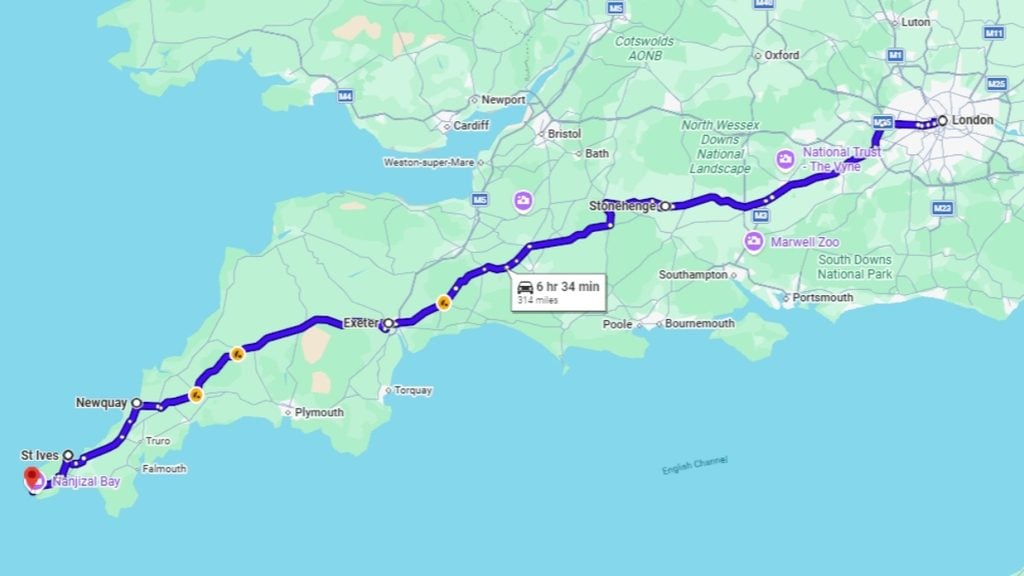
There are two driving routes that will take you from London to Cornwall. The first route (M4/M5/A30) is slightly longer but more reliable as you’re sticking to motorways for the majority of the journey. However, the second route (A303/A30) is more scenic and lets you zip through quaint towns and beautiful scenery, rather than being stuck on the motorway.
- M4/M5/A30 route: London → M4 west → M5 south at Bristol → exit at Exeter (junction 31) onto the A30. Slightly longer in miles but generally more reliable, since it’s motorway for most of the journey.
- A303/A30 route: A more scenic alternative through Wiltshire and Somerset, passing directly by Stonehenge. The A303 alternates between dual carriageway and single-lane stretches, which can cause delays, particularly around Stonehenge and Ilminster.
The best stops between London and Cornwall
Want to break up the drive between London and Cornwall? Exeter is the natural halfway point on either driving route, offering plenty of service stations and towns to stretch your legs.
If you’re opting for the scenic A303 route, Stonehenge and Glastonbury Tor are both worth building in as proper stops rather than drive-bys. Stonehenge dates back over 4,500 years and is an impressive UNESCO World Heritage Site, while climbing the steep conical hill at Glastonbury Tor is a perfect way to get some fresh air during your drive.
Your road trip map from London to Cornwall
Top tips for the drive from London to Cornwall
When it comes to the London to Cornwall drive, timing is everything. By departing midweek, you’ll be able to beat the peak traffic and bypass major bottlenecks that can form around Bristol and Exeter. Keep reading to discover everything you need to know before getting behind the wheel.
Driving conditions: what is the road from London to Cornwall like?
The road conditions are generally smooth between London and Cornwall. However, traffic and seasonal congestion are common, particularly if you’re travelling during the peak of summer or during a bank holiday weekend.
On the M4/M5 route, you’ll mostly be driving along motorways, while the A30 route alternates between dual carriageway and single-lane stretches.
Once off the main roads and into Cornwall’s towns and villages, expect narrow single-track lanes with passing places and high hedges limiting visibility. If you’ve never driven in this region before, a compact car with good handling is a smart choice.
Recommended type of car for the drive
A comfortable, reasonably compact car suits this trip well; easy enough for the motorway stretch, but manageable on Cornwall’s narrower lanes once you arrive. Renting through Turo means choosing a car sized right for both parts of the trip, rather than being stuck with whatever a rental branch’s fleet has in stock. Rent a car in London on Turo to tackle this road trip down to the Cornish coast.
How to stay safe on this road trip
The biggest consideration on the London to Cornwall drive is traffic and fatigue. Build in a proper break at the halfway point (Exeter or a services stop) rather than pushing straight through, and keep an eye on traffic conditions before setting off, particularly for summer weekend departures.
It can also be worth fuelling up in larger towns before heading into rural Cornwall, where fuel stations become less readily available.
Top places to stop along the way and in Cornwall
Before you reach Cornwall, there are plenty of places to stop and stretch your legs. Stop in at the historic Windsor Castle, visit ancient Roman Baths in Bath, or explore the historic abbey ruins in Glastonbury.
Stonehenge
If you’re taking the A303 route, Stonehenge is a must-see detour. In fact, the UNESCO World Heritage Site sits right alongside the road. Pre-booking a visitor centre slot lets you get up close to the stones and explore the surrounding Neolithic landscape, though even a slow drive-by gives a proper sense of scale. Allow at least an hour if you’re stopping properly, more if you want to walk some of the surrounding footpaths.

Exeter
As the road trip’s natural midway point, Exeter is a perfect place for a break (with plenty of independent shops and places to eat). The compact centre is easy to explore on foot, with the medieval cathedral and quayside both worth a wander if you’ve got time to stretch your legs. It’s a good spot to fuel up and grab lunch before tackling the final stretch into Cornwall.

St Ives
Situated on Cornwall’s north coast, St Ives is a well-known artistic seaside town. The town’s long-standing appeal to painters is still visible in its galleries and studios, alongside a lively harbour and a handful of excellent beaches right in town. Parking can get tight in peak season, so arriving earlier in the day makes exploring a lot easier. Expect narrow streets, sandy beaches, and a very walkable town to explore.

Newquay
Home to Cornwall Airport Newquay and a popular base for the north coast’s beaches, stopping in Newquay is a good option for travellers who want a livelier town base. Fistral Beach draws surfers year-round, while the town itself has a wider range of restaurants, pubs, and places to stay than some of Cornwall’s quieter coastal spots. It works well as a central base for exploring the north coast without having to move accommodation.

Padstow
A well-known foodie destination on Cornwall’s north coast, closely tied to celebrity chef Rick Stein, whose seafood restaurant and cookery school have helped put the town on the culinary map. Beyond Stein’s restaurants, the harbour is lined with independent cafés, bakeries, and seafood spots worth a wander, making it an easy place to build a lunch stop around. It’s a fitting addition to a coastal itinerary even for travellers who aren’t planning a full day trip to the area.
Land’s End
The dramatic westernmost point of mainland England, Land’s End is a fitting final stop for anyone driving the whole way down. Clifftop paths give sweeping views out over the Atlantic, and on a clear day you can pick out the Isles of Scilly on the horizon. It’s a proper “end of the road” moment, worth timing for late afternoon light if your schedule allows.

Driving in Cornwall once you arrive
Driving in Cornwall is a must, as public transport thins out significantly once off the main train line. Having your own car is incredibly useful for exploring beyond a single town.
In terms of driving conditions, narrow lanes and high hedges are a fact of life in rural Cornwall. Driving here is best done at a slower pace and with a bit of local awareness (pulling into passing places and watching for oncoming traffic on blind bends).
For visitors flying into Cornwall Airport Newquay or arriving by train, picking up a rental car locally in Newquay means avoiding the long drive altogether while still having a car for exploring the county once there.
The best things to see and do in Cornwall
Cornwall is a large county (roughly 80 miles north to south), making it best to pick a few of the best things to see and do based on what you’re near. If you’re visiting for an extended holiday, consider ticking off as many of these top sights and attractions as you can.
Best for foodies
- Padstow: Home to Rick Stein’s seafood restaurants and cookery school, plus independent cafés and bakeries lining the harbour.
- St Ives: Beyond its art scene, a growing food reputation with harbourside restaurants and seafood spots.
- Port Isaac: A working fishing village on the north coast, known for fresh seafood and a handful of well-regarded restaurants.
- Falmouth: A proper foodie scene has grown up around the harbour, from casual seafood shacks to more polished dining.

Best for families
- The Eden Project (near St Austell): Giant biome domes with rainforest and Mediterranean plant collections; a unique day out regardless of weather.
- St Michael’s Mount (near Penzance): A tidal island castle, walkable at low tide via a cobbled causeway or reachable by boat when the tide’s in.
- Tintagel Castle: Expect dramatic clifftop ruins tied to Arthurian legend, with a footbridge connecting the mainland to the headland; a hit with kids drawn to the castle-and-legend angle.
- Flambards (near Helston): A theme park with rides, a Cornwall-at-war exhibition, and an indoor Victorian village; useful for a rainy-day backup.


Best for beach lovers
- Fistral Beach (Newquay): Cornwall’s best-known surf beach.
- Porthcurno: A striking cove, among the most photogenic on the coast.
- Kynance Cove (Lizard Peninsula): One of the most scenic stretches of coastline in the country.

Frequently asked questions about the London to Cornwall drive
How long does it take to drive from London to Cornwall?
The drive is around 5 hours from London to the Cornwall border in clear traffic, extending to 5.5–6 hours for destinations further into the county like St Ives or Newquay.
What is the best route from London to Cornwall?
The M4/M5/A30 route is the most reliable from London to Cornwall, being motorway for most of the journey. The A303/A30 route is more scenic and passes Stonehenge, but includes single-carriageway stretches that can cause delays.
Is it worth driving from London to Cornwall instead of taking the train?
Driving from London to Cornwall takes longer than the direct Great Western Railway service from Paddington, but offers far more flexibility: the ability to stop at Stonehenge or Exeter along the way, and a car once in Cornwall, where public transport is limited outside the main towns.
Are there tolls on the drive from London to Cornwall?
The main M4/M5/A30 and A303/A30 routes are largely toll-free when driving from London to Cornwall. However, you might encounter city emission zones or local bridge tolls depending on your exact route.
When is the best time to drive to Cornwall to avoid traffic?
Midweek travel, or an early morning/evening departure if travelling on a weekend, helps avoid the worst congestion from London to Cornwall. Summer Saturdays are the busiest days of the year on the A30 and M5.
Explore Cornwall at your own pace with Turo
However you get down to Cornwall, having your own car allows you to explore all over once you arrive. Its narrow lanes, scattered beaches, and villages spread out along 80 miles of coastline are best uncovered at your own pace rather than sticking to a train timetable or a single town.
If you’re driving the whole way from London, Turo puts you behind the wheel of a car that suits both halves of the trip from the start. And if you’re flying into Newquay or taking the train down, browsing cars available to rent in Cornwall on Turo means you can pick up a car locally and start exploring the coast the moment you arrive.

Take control of your financial future and start building your car sharing business on Turo!
Get started
Browse thousands of cars for every occasion and budget near you, or wherever you’re going.
Browse cars
Lucinda Starr
Lucinda Starr is a travel and automotive writer with 5+ years of firsthand experience road-tripping across Australia, New Zealand, and beyond. She writes road trip guides for Turo, drawing on her experience behind the wheel to share practical insights on long-distance drives, destinations, and vehicles. Her travels have taken her across Australia’s East Coast, Victoria’s Great Ocean Road, the Northern Rivers, Byron Bay, and both islands of New Zealand. One of her most memorable journeys was an 11-day, 2,600+ km route from Auckland to Punakaiki and Queenstown. Lucinda has a particular passion for classic, rugged 4WD vehicles and the freedom they bring to exploring new places.