posted on May 19, 2026
If you’re wondering, “Do you need a passport to drive to Canada?”, the short answer is no — but a passport remains the easiest and most widely accepted option for crossing the border by car. Here’s what US travelers should know about accepted travel documents, passport alternatives, and preparing for a smooth border crossing.
In this guide:
- The short answer
- Accepted documents for US citizens driving to Canada
- Passport alternatives: what qualifies
- Special situations: permanent residents, children, and travelling with minors
- Getting back into the US
- Tips for crossing the border by car
- Frequently asked questions
The short answer
As a US citizen, you don’t technically need a passport to drive to Canada, but it’s still the option most strongly recommended by both US and Canadian authorities. There are alternatives if you don’t have a passport, but they’re more limited, less universally accepted, and can make border crossings slower or more complicated. A passport remains the simplest, fastest, and most flexible document to travel with.
Accepted documents for US citizens driving to Canada
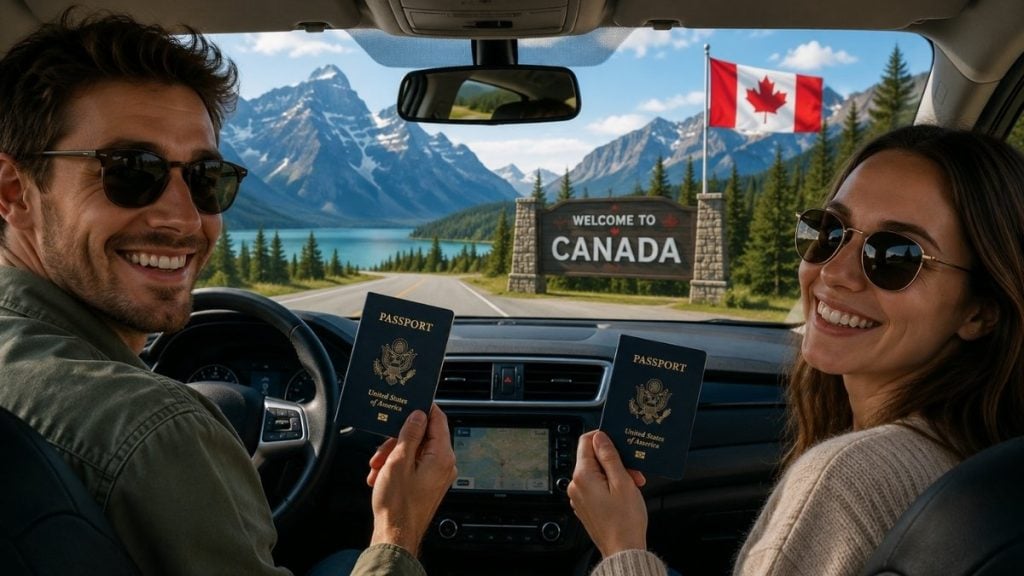
Canadian law requires all travellers entering the country to present proof of both citizenship and identity at the border.
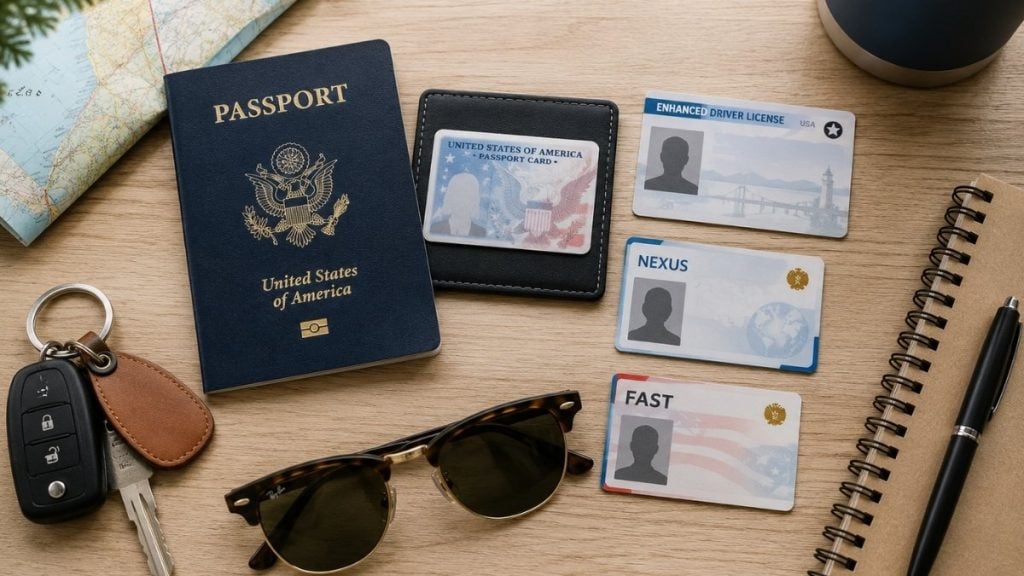
- US passport book — the most universally accepted document; valid for land, sea, and air travel
- US passport card — wallet-sized alternative valid for land and sea crossings only; not accepted for air travel. Less expensive than a passport book
- Enhanced Driver’s License (EDL) — accepted for land and sea crossings, but only available to residents of five states: Michigan, Minnesota, New York, Vermont, and Washington. Not the same as a REAL ID — REAL ID is not valid for crossing into Canada
- NEXUS card — a trusted traveller program card for pre-approved travellers, accepted at land crossings and select Canadian airports. Requires an application and an in-person interview
- SENTRI or FAST cards — other trusted traveller program cards, accepted at land crossings for eligible travellers
Note: a standard driver’s licence or birth certificate alone is not sufficient for US citizens to enter Canada by land. Rules tightened significantly under the Western Hemisphere Travel Initiative (WHTI) in 2009.
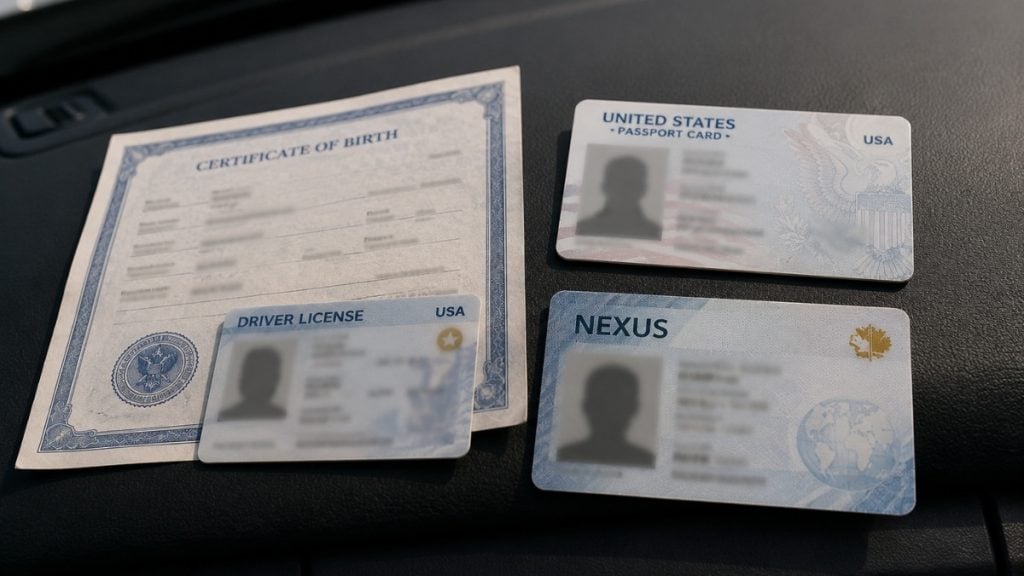
What about using a birth certificate for identification?
A birth certificate paired with a government-issued photo ID was once commonly accepted for land crossings into Canada, but that’s no longer considered a reliable option for adult travelers. While border officers may technically accept it in limited situations, neither the US nor Canadian government recommends relying on this approach, and there’s a real risk of delays or being turned away. If you don’t have a passport or a passport card, a NEXUS card is a much better alternative.
Special situations
US permanent residents
If you’re a US permanent resident driving to Canada, you’ll generally need to present a valid Permanent Resident Card (Green Card). A passport from your country of citizenship is not typically required for land or sea crossings, but carrying one is still recommended in case border officers request additional identification.
If you’re traveling by air, you must carry both a valid passport and your Green Card. If your Green Card has expired and you’ve already filed for renewal, bring your Form I-797 Notice of Action as proof of your pending renewal status.
Children under 16
Children under 16 traveling to Canada by land or sea can generally use an original or certified copy of their birth certificate as proof of citizenship, meaning a passport is recommended but not strictly required. Once a child is 16 or older, they must meet the same entry requirements as adults and carry an accepted travel document such as a passport or passport card.
Traveling with a minor who isn’t your child
Canadian border authorities take the welfare of minors seriously, especially when a child is traveling without both parents or legal guardians. If you’re traveling with a child who isn’t your own, or if you share custody, it’s strongly recommended that you carry a signed consent letter from the other parent(s) or guardian(s) authorizing the trip, including contact details, travel dates, and destination information. While this isn’t technically a legal requirement for entering Canada, border officers may ask for it at the crossing.
Native Americans / those registered under the Indian Act
Certain Indigenous people, including US citizens who are members of federally recognized tribes and people registered under the Indian Act, may have additional mobility rights when entering Canada. A Certificate of Indian Status or another recognized tribal membership document can generally be used at the border as proof of status and identity.
Getting back into the US
It’s just as important to understand the rules for re-entering the US from Canada before your trip. If you’re driving back across the border, the same WHTI-compliant documents apply, including a passport book, passport card, Enhanced Driver’s License, or NEXUS card. If you’re flying back into the US, however, you must carry a valid US passport book; passport cards, enhanced driver’s licences, and NEXUS cards are not accepted for air re-entry.
Tips for crossing the border by car
A little preparation goes a long way when driving between the US and Canada, especially at busy land crossings.
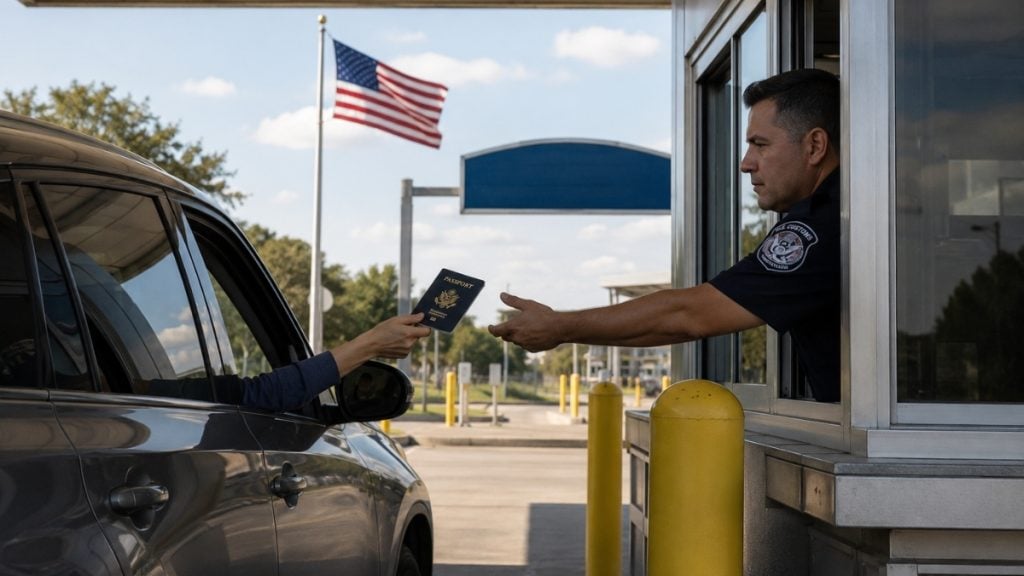
- Carry your documents in the car, not in your bag or in the trunk — you’ll need them immediately at the crossing window
- REAL ID is not enough — do not assume your state’s REAL ID-compliant driver’s license will get you across the border. It won’t. You need a WHTI-compliant document
- Check your passport expiry date — Canada requires your passport to be valid at the time of entry. If it’s close to expiring, renew before you travel
- Declare everything — be honest about what you’re bringing across. Items like firearms (Canada has strict gun laws), large amounts of cash (over CAD $10,000), and certain foods must be declared. Undeclared items can result in fines or being turned away
- Cannabis note — even though cannabis is legal in many US states and Canada, it cannot be transported across the border in either direction. Do not bring cannabis to a Canadian border crossing
- Arrive with time to spare — border crossing wait times vary significantly, particularly at busy crossings like Ambassador Bridge (Detroit/Windsor) or Niagara Falls. Check current wait times at the Canada Border Service Agency before you go
- Criminal record warning — Canada can and does deny entry to individuals with criminal records, including DUI convictions. If this applies to you, research your options (criminal rehabilitation application) well in advance of your trip
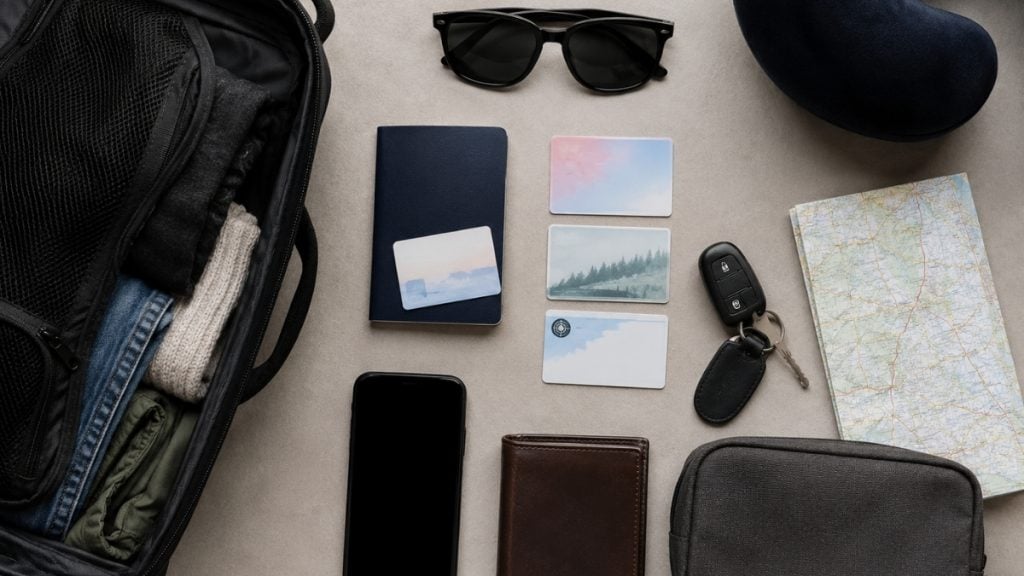
Tip from the author: If you cross the border even semi-regularly, a NEXUS card is worth looking into because it can save a huge amount of time at busy crossings. A passport card is also a handy backup option for road trips if you don’t want to carry your full passport book everywhere.
Frequently asked questions
Do I need a passport to drive from the US to Canada?
Not technically — but it’s the simplest and most reliable option. Accepted alternatives include a US passport card, an Enhanced Driver’s Licence (from Michigan, Minnesota, New York, Vermont, or Washington), or a NEXUS card. A standard driver’s licence alone is not enough.
Can I drive to Canada with just my driver’s licence?
No. A standard driver’s licence only proves you can legally drive — it doesn’t prove citizenship. You need a WHTI-compliant document that establishes both your identity and citizenship.
Can I use a passport card to drive to Canada?
Yes. A US passport card is accepted at land and sea crossings between the US and Canada. Note that it’s not valid for air travel — if you’re flying either to or from Canada, you’ll need a full passport book.
What is an Enhanced Driver’s Licence and do I have one?
An Enhanced Driver’s Licence (EDL) is a special version of a state driver’s licence that includes proof of citizenship via an embedded RFID chip. It’s accepted for land and sea crossings into Canada. However, EDLs are only issued by five states — Michigan, Minnesota, New York, Vermont, and Washington. If your state isn’t on that list, you don’t have one. EDLs are different from REAL ID — REAL ID is not accepted at the Canadian border.
Can my child cross into Canada without a passport?
Children under 16 traveling by land or sea can use an original or certified copy of their birth certificate. Children 16 and over must meet the same document requirements as adults. A passport is always the recommended option regardless of age.
Do I need a visa to visit Canada?
US citizens do not need a visa to visit Canada for stays of up to 180 days. You do need a valid travel document (see above). For stays longer than 180 days, or for purposes other than tourism (work, study, immigration), different rules apply — check canada.ca for current requirements.
Can I drive a car booked on Turo to Canada?
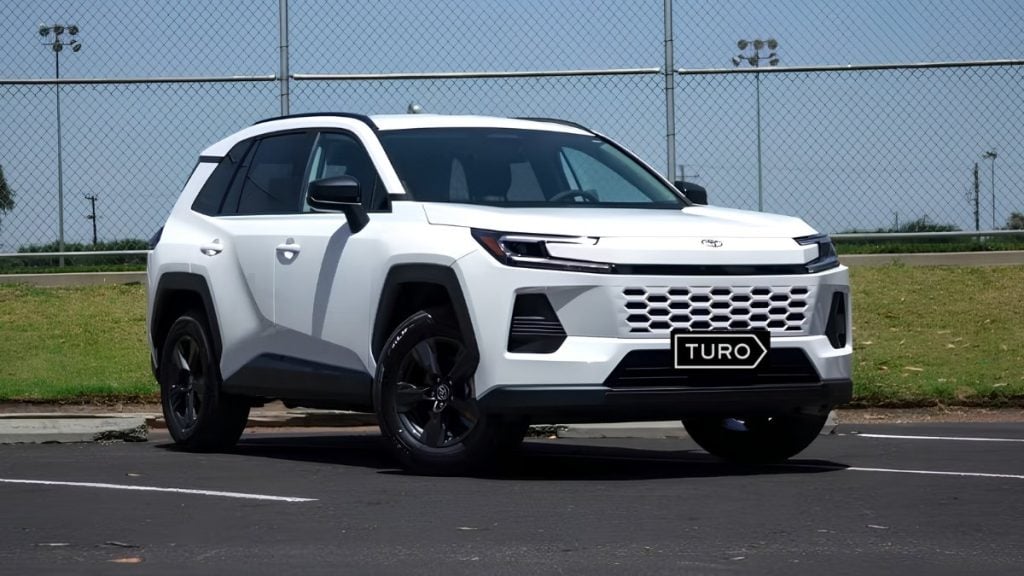
Yes, if you book a vehicle through Turo in the US, you’re allowed to drive it across the US-Canadian border. Turo currently allows trips between the US and Canada, provided the host permits it, and the vehicle is eligible for cross-border travel, though driving into Mexico is not permitted. For the latest requirements and details, check Turo’s border crossing guidelines.
Planning a road trip to Canada?
Canada is one of the best road trip destinations you can reach from the US, whether you’re planning a long weekend in Montreal or Vancouver, driving through the Canadian Rockies, or crossing the border near Niagara Falls. Once your travel documents are organized, the hardest part is done; the rest is just hitting the road in style.
If you want a specific type of vehicle for the trip, something comfortable for long highway drives, better on fuel, or roomy enough for the whole family, it’s worth browsing cars on Turo before you leave. Turo has vehicles available across the US, including cities near major Canadian border crossings, making it easy to find the right car for the drive north.
The information provided in this article is for general informational and educational purposes only and does not constitute legal advice. Please verify the most up-to-date requirements before you travel.
Share your car, earn extra cash
Cover your car payments or earn some extra cash by sharing your car whenever you’re not using it.
Get startedHit the road
Browse thousands of cars for every occasion and budget near you, or wherever you’re going.
Browse cars
Maddison Stewart
Maddy Stewart is a Sydney-based writer originally from Aotearoa, New Zealand, with a love for road trips and discovering places off the beaten track. Having driven the length of New Zealand many times, her favourite journeys are through the bottom of the South Island - especially Central Otago, which she considers a dream. She’s also explored parts of Australia by car and is currently looking forward to discovering Europe’s best vintage shops, seaside towns, and hidden gems on her next adventure.