posted on August 19, 2026
From the towering sandstone cliffs of Zion National Park to the vivid Grand Prismatic Spring at Yellowstone National Park, America has no shortage of incredible national parks to visit. For outdoor enthusiasts, these parks are best experienced at your own pace.
The best rental cars for national park trips allow you to pull over for an unexpected overlook, linger at a trailhead, and leave before the crowds arrive. With the right vehicle, everything from timing wildlife sightings to bringing all the gear for mountain biking becomes possible.
In this guide, we walk you through the top vehicles for every kind of national park trip, with guidance on cargo space, fuel efficiency, and budget considerations.
In this guide, we’ll be covering:
- What to look for in a national park rental car
- Best rental cars for national park trips by type
- The best rental cars for specific national parks
- Tips for renting a car for a national park road trip
- Frequently asked questions
What to look for in a national park rental car
Picking the right car to rent depends on which kind of national park you’re planning to visit, how far you’re traveling, and how much gear you’re bringing. All the best cars for a national park road trip have these traits in common:
- Fuel efficiency: National park drives involve long stretches of highway, with sometimes hundreds of miles of open road between major stops. A fuel-efficient vehicle keeps running costs lower and reduces the number of times you need to hunt for a gas station in remote areas.
- Cargo space: Hiking boots, day packs, layers, a cooler, and camping gear add up quickly. A vehicle with enough trunk space or fold-flat rear seats makes packing and accessing gear much easier.
- Comfort on long drives: Most national park trips involve extended time in the car. A comfortable seat and smooth highway ride matter, especially if you’re on the road for upwards of 5+ hours.
- Reliability: Remote areas around national parks tend to have limited roadside assistance options. A reliable, well-maintained vehicle is not a nice-to-have.
- AWD for winter and mountain parks: Many national parks have roads that can be snowy, wet, or icy at certain times of year. AWD provides added confidence in these conditions.
- Size and maneuverability: National park parking lots and scenic pullouts can be tight, and a very long or wide vehicle is harder to maneuver and park in busy summer conditions.
Best rental cars for national park trips by type
Before you venture into the great outdoors, it’s important to consider which type of vehicle is best suited to your trip. Depending on your group size, amount of gear, and the specific park you’re visiting, here are the top vehicles to consider renting.
Best compact SUVs and crossovers
Compact SUVs and crossovers are the sweet spot for most national park visitors: compact enough to park easily, spacious enough for gear, and fuel-efficient enough for long drives.
Subaru Outback
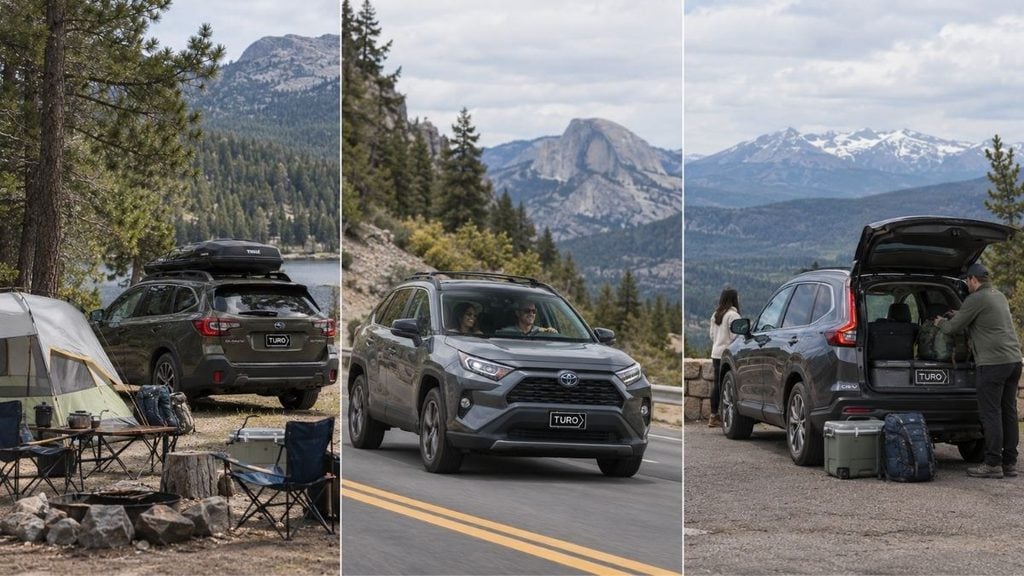
Looking for a car that’s made for a national park road trip? The Outback is it, offering standard AWD on every trim, a flat cargo floor with up to 75+ cubic feet of space (with rear seats folded), and roof rails ideal for a cargo box or bike rack. It’s comfortable over long distances, handles well in all weather conditions, and is widely available to rent on Turo across the country.
- Best for: Couples and small families looking for AWD, excellent ground clearance, and plenty of space for hiking and camping gear.
- Fuel economy: ~26 city / 33 highway mpg
- Cargo space (seats folded): ~75 cu ft
Toyota RAV4
There’s a reason the Toyota RAV4 is one of the most popular SUVs in America. This car offers the perfect balance of cargo space, AWD availability, and a comfortable cabin for long drives (like Utah’s Mighty 5 or around the Grand Canyon). If you’re looking to save money on gas, consider renting the RAV4 Hybrid (reaching up to 38 mpg combined).
- Best for: Small groups or couples needing a car that can handle roads with confidence and carry gear in the back of the vehicle.
- Fuel economy: ~27 city / 35 highway mpg (gas); ~41 city / 38 highway mpg (hybrid)
- Cargo space (seats folded): ~70 cu ft
Honda CR-V
Planning to camp in a national park, and bringing plenty of gear like tents and sleeping bags? If you need a reliable drive, you can’t go wrong with the Honda CR-V. Expect a comfortable interior, generous cargo space, and the elevated driving position many drivers appreciate. For a quiet, smooth, and fuel-efficient drive, consider renting the CR-V Hybrid (it’s an especially good choice for long-distance trips).
- Best for: Road trippers traveling cross-country and searching for a vehicle that will go the distance.
- Fuel economy: ~28 city / 34 highway mpg (gas); ~43 city / 36 highway mpg (hybrid)
- Cargo space (seats folded): ~76 cu ft
Best midsize SUVs for families and groups
Traveling with a larger group or plenty of gear? From camping equipment to bikes and multiple bags, these midsize SUVs provide the extra space without sacrificing on too much fuel economy.
Toyota Highlander
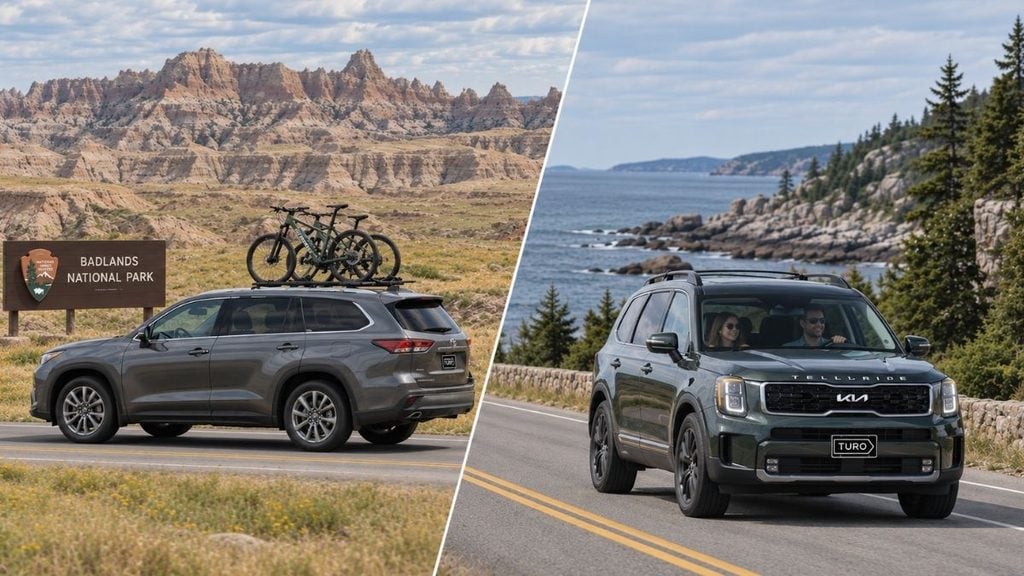
The Toyota Highlander is made for tackling rugged backcountry roads with plenty of passengers and cargo. Expect three rows, up to 84 cubic feet of cargo space (with all seats folded), and standard AWD on most trims. This is one of the best all-rounder family national park vehicles on the market, ideal for staying comfortable on longer drives and navigating tight parking lots with surprising maneuverability.
- Best for: Families of 4+ tackling long drives and looking for a car that can confidently handle changing weather conditions.
- Fuel economy: ~21 city / 29 highway mpg (gas); up to 36 mpg combined (hybrid)
- Cargo space (seats folded): ~84 cu ft
Kia Telluride
Looking for a spacious cabin, highway-assist technology, and smooth handling on steep mountain roads? The Kia Telluride is a three-row SUV that’s consistently praised for comfort, space, and a generous cargo area. It’s one of the best options for a family park road trip where interior comfort over long drives is a priority.
- Best for: Multigenerational families traveling with adults of all ages and searching for a comfortable cruise along the highway.
- Cargo space (seats folded): ~87 cu ft
Best vehicles for gear-heavy trips
For trips involving bikes, kayaks, large coolers, or camping equipment, cargo capacity becomes the primary consideration. Luckily, these cars are well-suited to gear-heavy national park trips.
Subaru Outback (with roof rack)
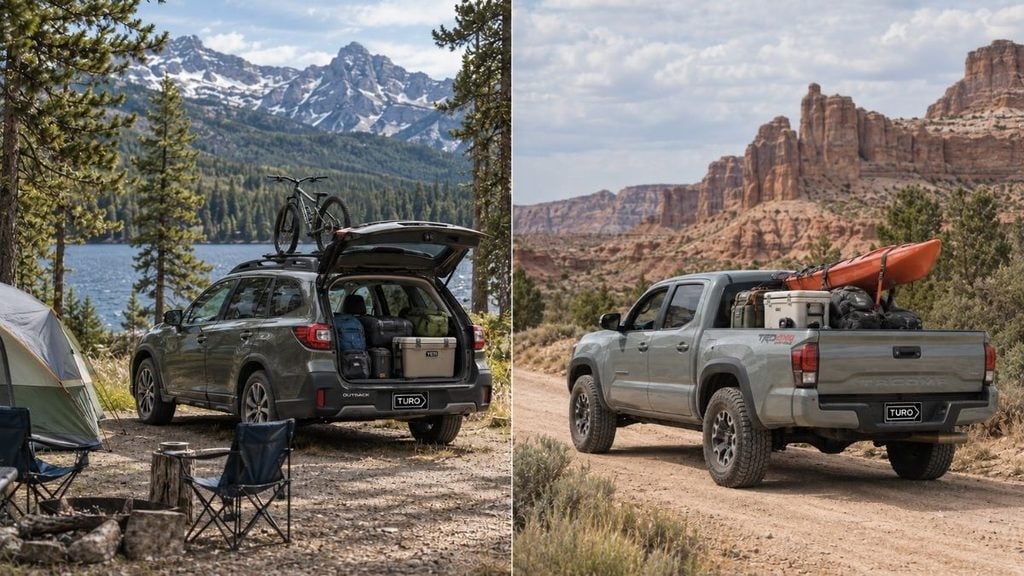
The Outback has already made this list, but it deserves a second mention. Many Outback listings on Turo include factory roof rails ready for a cargo box or bike carrier. This adds significant cargo capacity that’s ideal for gear-heavy trips. See above for full car details.
Toyota Tacoma
For trips where hauling gear is the priority, a pickup truck’s open bed offers unmatched flexibility. The Tacoma is the most popular mid-size pickup in the US: reliable, well-regarded, and available in most gateway cities on Turo. The truck bed handles bulky gear (coolers, kayaks, and large bags) without filling up the passenger cabin. While fuel economy is lower than a crossover, this is a strong option for a small group with substantial equipment.
- Best for: Campers heading to remote areas and bringing bulky items like kayaks or mountain bikes.
- Fuel economy: ~20 city / 24 highway mpg
- Bed length options: 5 ft or 6 ft depending on trim
Best fuel-efficient cars for solo travelers and couples
Looking for a car that costs less to rent? From compact cars to fuel-efficient sedans, these vehicles are best suited to solo travelers and couples with minimal gear.
Toyota Prius
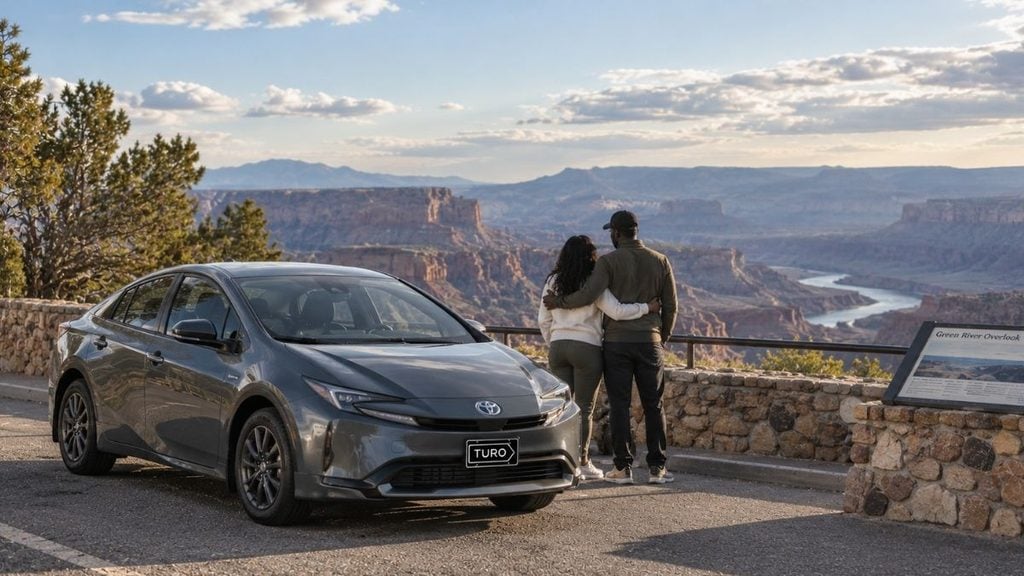
Looking for one of the most fuel-efficient, non-electric cars you can rent for a national park road trip? The Toyota Prius is spacious for a compact car, and the hatchback opening accommodates more gear than you’d expect.
- Best for: Solo travelers or couples driving between national parks and looking to keep fuel costs low across hundreds of miles.
- Fuel economy: Up to 57 mpg combined
Honda Civic Hatchback
The Honda Civic Hatchback is a well-rounded compact car with a practical hatchback opening and fold-flat rear seats that expand cargo space to 46+ cubic feet. It’s a classic all-rounder: comfortable on the highway, easy to park in busy national park lots, and fuel-efficient at around 42 mpg highway.
- Best for: Budget-conscious travelers looking for nimble handling and excellent fuel efficiency.
- Fuel economy: ~32 city / 42 highway mpg
The best rental cars for specific national parks
The best vehicle for your national park trip also depends on the specific park. Here’s a quick guide to matching car type to your destination.
- Grand Canyon (Arizona): The South Rim’s main scenic roads are fully paved and accessible to any standard vehicle. A comfortable SUV or sedan works well, as cargo space is the main consideration. A fuel-efficient vehicle is worth prioritizing given the long drive from Phoenix (~3.5 hours) or Las Vegas (~2.5 hours).
- Recommended car to rent: Toyota Rav4 Hybrid or Honda CR-V Hybrid
- Yellowstone (Wyoming): Yellowstone’s 466-mile Grand Loop Road is fully paved and accessible in any standard vehicle. The drives between park sections are long (up to 50–60 miles between major areas), making fuel efficiency a consideration. An AWD crossover or SUV provides added confidence on mountain approaches during the shoulder seasons, when conditions can be variable.
- Recommended car to rent: Subaru Outback
- Zion National Park (Utah): Zion Canyon Scenic Drive is closed to private vehicles during shuttle season (spring through fall). The Zion–Mt. Carmel Highway is always open to private vehicles and is a spectacular drive in any car. A compact car or sedan is easier to manage in Springdale’s busy parking areas.
- Recommended car to rent: Toyota Corolla or Honda Civic Hatchback
- Olympic National Park (Washington): Olympic National Park is one of the most geographically diverse parks in the country: rainforest, alpine ridge, and Pacific coast sections are spread across a large area connected by highway. An AWD vehicle is useful given the Pacific Northwest’s wet weather. A mid-size SUV with good cargo space handles the varied conditions and multi-section exploring well.
- Recommended car to rent: Subaru Outback for wet Pacific Northwest conditions
- Rocky Mountain National Park (Colorado): Trail Ridge Road (the highest paved road in the US, reaching 12,183 feet) is accessible to standard vehicles during its open season (typically late May through mid-October). An AWD crossover adds confidence on approaches during early and late season when conditions can be variable.
- Recommended car to rent: Toyota RAV4
- Big Bend National Park (Texas): Big Bend is one of the most remote parks in the country; the nearest major city (San Antonio) is over 4 hours away. Fuel efficiency is particularly important given the long drives involved and limited fuel availability within and around the park. A reliable crossover with good fuel economy and ample cargo space is the most practical choice.
- Recommended car to rent: Volkswagen Atlas for bigger groups (it can comfortably accommodate up to seven passengers)
Looking for an itinerary to get started? Consider the Las Vegas to Grand Canyon road trip or the Denver to Yellowstone road trip.
Tips for renting a car for a national park road trip
Before you hit the road, brush up on this expert advice to enjoy a smooth, safe, and comfortable national park road trip.
- Book your rental car early: National park gateway cities (such as Springdale for Zion National Park or Gardiner for Yellowstone National Park) have limited car rental supply, especially in peak summer season. Book well in advance for summer or holiday weekend travel.
- Get an America the Beautiful Pass: At $80/year, the America the Beautiful Annual Pass covers entrance fees at all US national parks and federal lands. For anyone visiting two or more parks, it typically pays for itself.
- Download offline maps before you leave cell coverage: Cell service disappears completely in many national park areas. Download your driving route and park maps before leaving the last town with reliable signal.
- Top off your tank before entering remote parks: Gas is not available inside most national parks, and gateway town stations can be expensive. Fill up in the nearest town before entering.
- Bring more gear than you think you need: National park weather can change rapidly, especially at altitude. Pack layers, rain gear, and sturdy footwear regardless of the forecast.
- Browse Turo for the right vehicle near your starting point: Want more flexibility than traditional car rental agencies? On Turo, you’ll find a wide range of vehicles (from fuel-efficient hybrids to spacious SUVs) so you can find the right fit for your specific trip rather than accepting whatever a traditional rental counter has available.
Frequently asked questions about rental cars for national park trips
What is the best rental car for a national park road trip?
For most national park visitors, a compact SUV or crossover (like the Subaru Outback, Toyota RAV4, or Honda CR-V) hits the best balance of cargo space, fuel efficiency, and AWD capability. Solo travelers and couples with minimal gear can do very well in a fuel-efficient compact like the Toyota Prius. Families or those with significant gear benefit from a midsize SUV like the Toyota Highlander or Kia Telluride.
Do you need a 4WD vehicle for national parks?
No; all of the main paved scenic drives, visitor centers, and primary trailheads at US national parks are accessible in a standard passenger car. AWD provides added confidence in wet, snowy, or icy conditions at mountain parks in shoulder seasons but is not required for a typical national park road trip. A reliable, well-maintained standard vehicle handles the vast majority of national park driving.
Should I rent a car or take a tour for national parks?
Renting a car gives you the most flexibility when visiting national parks. You can stop wherever you want, set your own schedule, and linger at viewpoints without being tied to a tour group’s itinerary. For first-time visitors to remote parks, a guided tour for specific activities can be combined with a rental car for the broader road trip.
How far in advance should I book a rental car for a national park trip?
For summer travel (June to August) to popular parks like the Grand Canyon, Yellowstone, and Zion, book your rental car at least 4–6 weeks in advance; gateway city supply is limited and prices increase with demand. For spring and fall travel, 2 to 3 weeks ahead is usually sufficient. Browse Turo for flexible pick-up options near your destination.
Find your perfect national park rental car on Turo
The right rental car takes a national park road trip from good to great: the flexibility to stop whenever you want and the ability to cover over 400 miles of open road comfortably.
Looking for the right car for your next outdoor adventure? Browse Turo for SUVs, crossovers, hybrids, and trucks from local owners near your national park starting point. Flexible pick-up options and a wide range of vehicle types mean you can find exactly what your trip needs.
Share your car, earn extra cash
Cover your car payments or earn some extra cash by sharing your car whenever you’re not using it.
Get startedHit the road
Browse thousands of cars for every occasion and budget near you, or wherever you’re going.
Browse cars
Lucinda Starr
Lucinda Starr is a travel and automotive writer with 5+ years of firsthand experience road-tripping across Australia, New Zealand, and beyond. She writes road trip guides for Turo, drawing on her experience behind the wheel to share practical insights on long-distance drives, destinations, and vehicles. Her travels have taken her across Australia’s East Coast, Victoria’s Great Ocean Road, the Northern Rivers, Byron Bay, and both islands of New Zealand. One of her most memorable journeys was an 11-day, 2,600+ km route from Auckland to Punakaiki and Queenstown. Lucinda has a particular passion for classic, rugged 4WD vehicles and the freedom they bring to exploring new places.